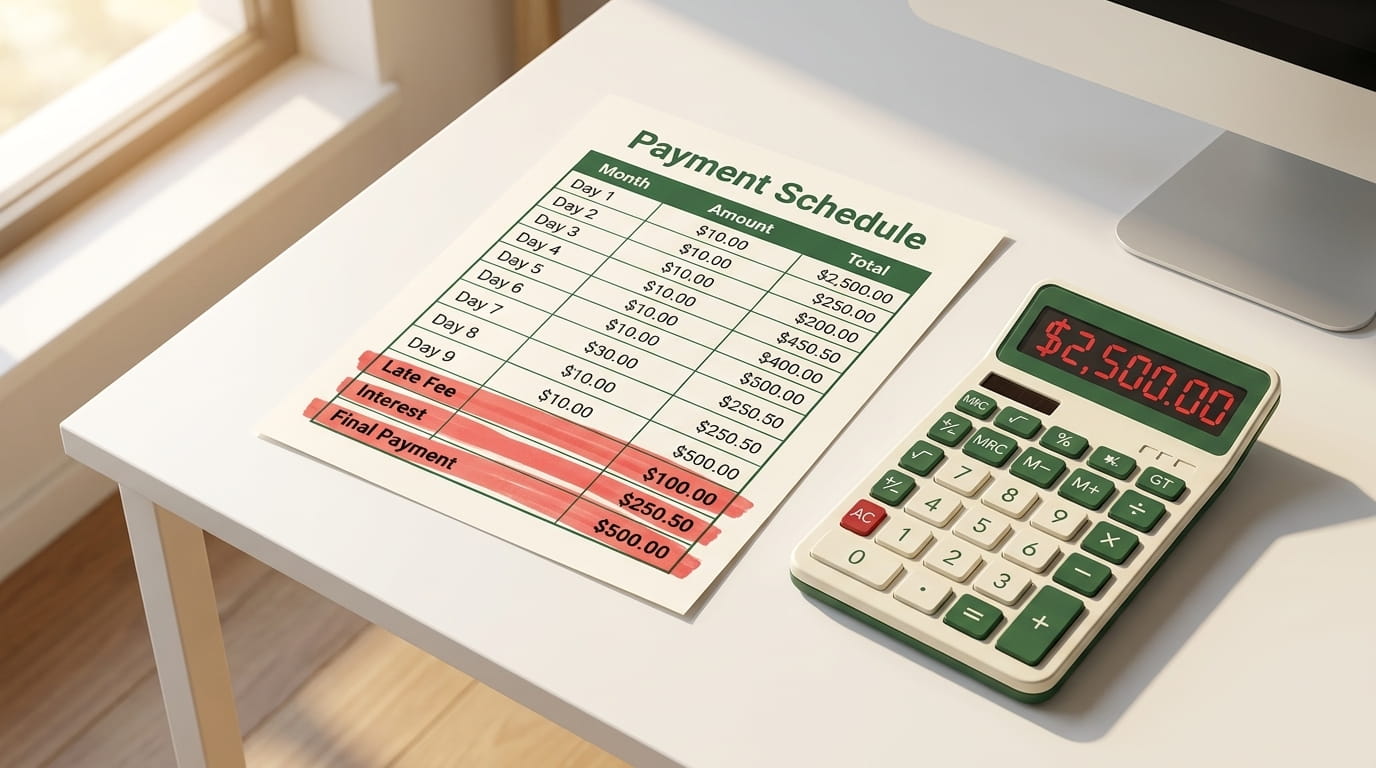
Last December I bought a new winter coat. Not an exciting story; the coat cost $340. At checkout the merchant offered to break it into four interest-free payments of $85, spaced two weeks apart. I read the disclosure. The interest rate was, genuinely, zero. There was no fee for paying on time. The promise was real.
I paid up front. The reason I paid up front is not financial in the narrow sense — it is the boring reason I want to argue for here, because the usual case against BNPL ("it's a debt trap" / "the late fees are predatory") is half-true and only sometimes applies. The other half of the case is structural, and I think it is the stronger one.
What BNPL promises
The pitch is simple: split your purchase into 3–4 interest-free installments. No credit check or only a soft inquiry. No effect on your credit score, in most cases. No interest if you pay on time. The merchant pays a fee to the BNPL provider; you, the customer, allegedly pay nothing.
For the simple "pay-in-four" products this is genuinely the deal. The longer ones — six to twenty-four months — usually do carry interest, often at rates similar to a credit card. We will set those aside; the structural argument applies to both.
The math on "free"
Studies of BNPL usage — most notably the CFPB's 2022 and 2023 reports — find that users of pay-in-four products are about twice as likely as non-users to incur an overdraft fee on their bank account in the same month. The reason is mechanical: an autopay scheduled two weeks out is something most people forget about, and a $85 charge against a $63 balance triggers a $35 overdraft. The product itself charged you nothing; the bank charged you the equivalent of a 220% interest rate on the missed instalment.
The CFPB also reports that around 18% of BNPL users have at least one late payment in a given year. Late fees on pay-in-four are usually $7–$10. Manageable for one purchase; less manageable when the user has, on average, three to five BNPL purchases active at once.
A product can be free on paper and expensive in practice. The trick is to find out which one you are using before you sign up.
The reason I do not use them
Here is the structural reason. BNPL exists to make a $340 coat feel like an $85 coat at the moment of purchase. That is the entire product. The deferral is not the feature; the perceptual shrinkage is.
I am, by introspection, not immune to that. If I am offered the same coat at $85 today and three further $85 instalments out into the future, I will buy a slightly more expensive coat than the one I would have bought at $340 up front. The data backs this up. A 2023 study of US online retailers found that average order value rose by 30–50% on transactions completed via BNPL.
The thing the product is selling, in other words, is not financing. It is the ability to spend more than you otherwise would. I do not want to spend more than I otherwise would. So I do not use the product. It is not that I am at risk of missing a payment; it is that the product is doing its job by making me buy a coat I would not have bought.
The narrow case where it works
There is one case where I think BNPL is a defensible tool, and it is narrow. You have already decided to buy something. You have the money in cash. You are using BNPL purely to keep your monthly cash flow smoother — splitting a $1,000 expense across two pay cycles, for example, even though you could have paid up front. You will pay on time, because you have the money.
That is a tiny minority of BNPL use cases. The rest is the perceptual-shrinkage product I just described.
What to use instead
For the cash-flow case: a credit card paid in full at month-end, with the autopay set to the full statement balance. You get the same deferral, you get card rewards, you get fraud protection that BNPL does not always offer, and the autopay is one calendar event instead of four.
For everything else: a sinking fund. The $340 coat needed $28 a month set aside for a year. I had been doing that for the previous eight months because last winter taught me that one was coming. The coat felt cheap on the day I bought it; that is the trick the sinking fund plays, except the trick is on me, not by the merchant.