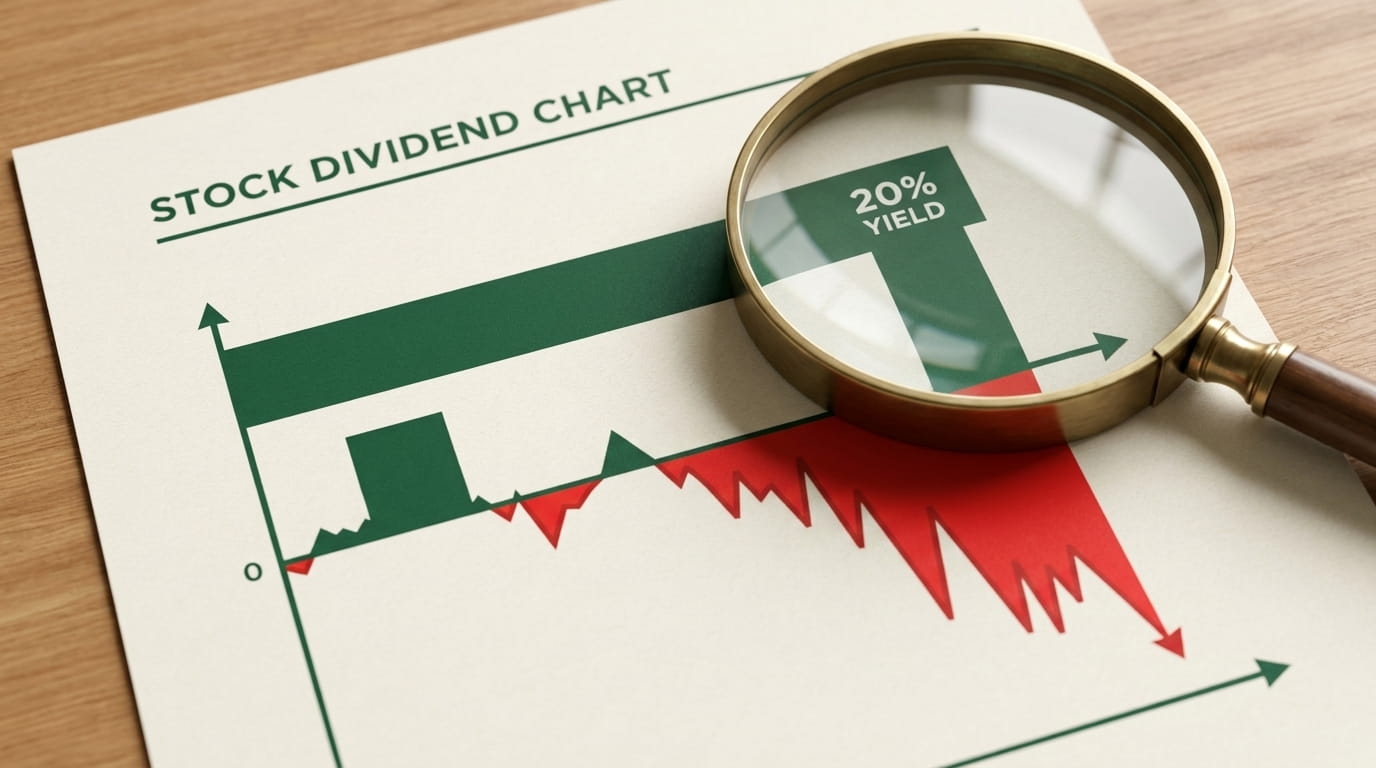
A dividend is a cash payment from a company to its shareholders. The company splits some fraction of its profits into a per-share number and sends it to the people on its share register on a specific date. That is the whole mechanism. Most of the writing around dividends complicates this; the complication is mostly marketing.
Where beginners get into trouble is not in understanding what a dividend is. It is in confusing "high yield" with "high return." They are different numbers, they move in opposite directions sometimes, and the way the highest-yielding stocks earn their high yields is rarely what the new investor assumes.
What a dividend actually is
If a company earns $4 of net income per share in a year and decides to pay $2 of that to shareholders, the dividend is $2 per share. The remaining $2 stays with the company — invested in operations, used to buy back shares, or held as cash. The portion of earnings paid out is the payout ratio, in this case 50%.
Most US dividend-paying companies pay quarterly: four equal instalments of, in our example, $0.50 a quarter. Most European companies pay annually or semi-annually in larger lumps. The mechanics are otherwise the same.
Dividends are taxed. In the US, "qualified" dividends — most dividends from domestic stocks held for at least 60 days around the ex-dividend date — are taxed at long-term capital gains rates, which are lower than ordinary income rates. Ordinary (non-qualified) dividends are taxed at your marginal income rate. The difference matters more in a taxable account than in an IRA or 401(k).
The yield equation, slowly
The dividend yield is, simply:
Yield = Annual dividend per share ÷ Current share price
If a stock trades at $40 and pays $2 a year in dividends, the yield is 5%. If the same stock falls to $20 and the dividend is unchanged, the yield rises to 10%. A rising yield is, mathematically, often a sign of a falling price — not a more generous company.
This is the single most important sentence in this article: a yield that has risen because the share price fell is not the same kind of yield as one that has risen because the dividend went up. The new investor sees "10%" and assumes the latter. The former is more common.
Three classic yield traps
Trap one — the rolling-decline yield
A company's revenue is shrinking, its profits are shrinking, but management is reluctant to cut the dividend (because doing so would crash the stock further). They hold the per-share dividend constant. The share price drifts down. The yield, mechanically, climbs. By the time it reaches 9%, the market is already pricing in a cut. The cut arrives, the price falls another 25%, and the post-cut yield is back to 4% — on a price 50% below where the investor bought in.
Trap two — the payout-above-100% yield
The company's earnings have dropped to a point where the dividend is now larger than net income. Management may keep paying it by borrowing, selling assets, or running down cash reserves. This is usually a one- or two-year situation that resolves with either a recovery or a cut. The yield looks great in the moment; the underlying math is unsustainable.
Trap three — the high-yield sector concentration
The highest yielders in the US market cluster heavily in three sectors: tobacco, telecoms, and oil & gas. Each of these has long-running secular questions about whether the business model will look the same in twenty years. A beginner who builds a portfolio of "the 10 highest yielders" usually ends up with a portfolio that is two-thirds three sectors, all of which are facing the same long-term pressures. That is concentration risk dressed up as income.
A 9% yield is the market telling you something. The interesting question is what it is telling you, not what the headline number is.
A simple beginner screen
Five filters that will not catch every problem but will catch most:
- Yield under 6%. Above 6%, the chance the market is signaling a problem rises sharply. Not always — REITs, for example, structurally yield more — but as a starting filter, 6% works.
- Payout ratio under 70%. Leaves room for one bad year without a cut.
- Five years of consecutive dividend payments at minimum. Filters out new dividend programs that have not been tested.
- Dividend growth, not flat. Five-year dividend CAGR of at least 3% — roughly inflation. A flat dividend in nominal terms is a shrinking dividend in real terms.
- Free cash flow coverage of the dividend. Dividends paid out should be less than 80% of free cash flow. If the company cannot fund the dividend from its actual cash generation, it is funding it some other way, which is rarely durable.
None of this is sophisticated. All of it is publicly available data, free, on any major broker's research page.
How I would start in 2026 if I were starting now
If I were starting from zero, I would probably not start by picking individual dividend stocks. I would start with a low-cost dividend-focused ETF — SCHD, VYM, or DGRO are the three I cover in a comparison piece — and let the fund do the screening.
The reasons are unromantic. Expense ratios on these funds are around 0.06%, which is essentially free. The diversification is genuinely better than what an individual investor with $10,000 can build manually. The tax reporting is one line at year-end. And the discipline of holding 100+ names blunts the impact of any single dividend cut.
The case for picking individual names instead is real but narrow: you have a specific reason to overweight a name, you are paying attention to it, and you are willing to do the work to read its 10-K each year. I do both — about 70% of my dividend exposure is in SCHD, and the other 30% is in roughly twelve individual names I have been holding for years. That mix is not a recommendation. It is a personal balance between cost and conviction.
Two final notes. First: in a taxable account, dividends create a tax bill every year, whether you reinvest them or not. In a Roth IRA or HSA, they do not. If you have the room, dividend strategies are more powerful inside a tax-advantaged account. Second: ignore the daily price action. The whole point of a dividend strategy is the cash, not the quote.