I am going to walk through this slowly because the mistake is common and the cost, when you make it, is not the immediate tax bill — it is the years of compounding lost while you are sorting it out. If you are about to do a backdoor Roth and you have not read the words "pro-rata rule" until you can explain them to a friend, please stop and read this first.
Setup: who the Roth is for
A Roth IRA is an individual retirement account funded with after-tax money. The contributions you put in have already been taxed. Inside the account, investments grow tax-free, and qualified withdrawals in retirement are tax-free. It is, by far, the most generous retirement wrapper available to US individual investors.
There is a catch. You can only contribute directly if your modified adjusted gross income is below a certain threshold — in 2026, the phase-out for single filers runs from $146,000 to $161,000. Above that, direct contributions are not allowed.
The backdoor, briefly
The "backdoor Roth" is the legal workaround. The two steps:
- Contribute up to the annual maximum ($7,000 in 2026) to a traditional IRA. There is no income limit on traditional IRA contributions, only on the deduction.
- Convert that traditional IRA balance to a Roth IRA. The conversion is a taxable event — you pay income tax on the amount converted minus your basis — but if you converted the same year you contributed and held nothing else in pre-tax IRAs, the tax should be approximately zero.
That last clause is the trap.
What I did wrong
In 2018 I had rolled over an old employer 401(k) into a rollover IRA. The balance, at the time of my 2019 backdoor attempt, was $38,400. I made a $6,000 non-deductible contribution to a new traditional IRA in January 2019 and converted it to a Roth in March 2019. I assumed the only thing the IRS cared about was the $6,000.
The IRS cares about the pro-rata rule. When you have multiple traditional IRA balances — including SEP-IRAs, SIMPLE-IRAs, and rollover IRAs from old 401(k)s — and you convert any of them, the IRS treats your entire pre-tax IRA balance as one pool. The portion of the conversion that is treated as "after-tax basis" is proportional to the share of your total balance that was after-tax.
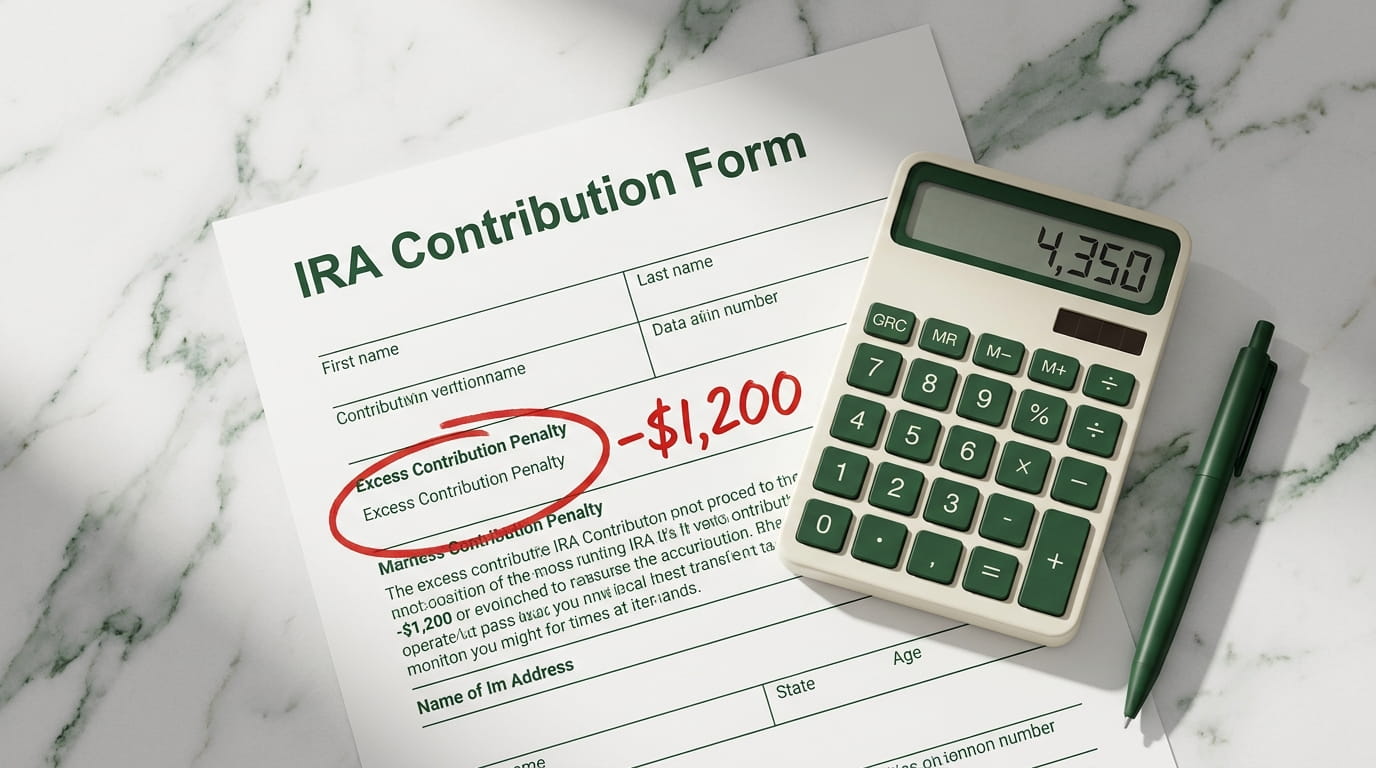
In my case: $6,000 of after-tax basis ÷ $44,400 total traditional IRA balance = 13.5% basis. The other 86.5% of my $6,000 conversion was treated as taxable income. At my marginal rate that year (32%), I owed roughly $1,660 of federal tax on a conversion I had assumed was tax-free.
The direct dollar cost was $1,660. The opportunity cost is what cost me more.
How I cleaned it up
I had two options. Option one was to keep doing the backdoor while owing pro-rata tax every year. Manageable, but suboptimal forever. Option two was to roll the pre-tax rollover IRA back into an active employer 401(k) — which, unlike IRAs, do not count toward the pro-rata calculation — and clear the path for tax-free backdoors going forward.
I took option two. My employer at the time did accept rollovers into the 401(k); not all plans do. The mechanics were: open a 401(k) rollover ticket with the plan, fill out the receiving form, request the IRA balance be transferred via direct rollover. The whole process took six weeks and one phone call. From the year after, backdoor conversions were clean.
The $1,660 of federal tax in 2019 was unrecoverable. The compounding I missed by waiting two years to get the structure right — because in 2020 I did not do a backdoor at all, paralyzed by the prior year — is the $4,200 number in this article's headline. That is back-of-envelope: two years of $6,000 contributions that I did not make, multiplied by six years of compounding at roughly 9% annualized, against a baseline where I made them.
The expensive part of a Roth mistake is not the tax bill. It is the years you sit out the contribution while you figure out how to fix it.
Four rules I follow now
- Check your pre-tax IRA balance before doing a backdoor. If it is more than zero, the conversion is not tax-free. Plan for the pro-rata math or roll the balance into a 401(k) first.
- Do the contribution and conversion in the same calendar year. Holding the contribution in the traditional IRA for several months has no benefit and creates tax complexity if it gains value before conversion.
- File Form 8606 every year you contribute non-deductible. Even if it feels like paperwork for $6,000. Years from now, when you start withdrawing, the 8606s are the proof of your basis.
- If you mess it up, do not freeze. Pay the tax, fix the structure, get back on schedule. Sitting out the contribution is the worse outcome.
Two paragraphs that I wish someone had put in front of me in 2019. The good news is the steps are clear once you read them in the right order.